
Right now, with my MacBook closed in my bag, I can open my phone and ask “what’s due this week?” and get an answer from my own notes. I can say “I met Adi, he’s at X, we talked about Y” and it lands in my vault.
Claude and Codex share one memory. I tell one of them something, and the other already knows.
None of this is one product. It’s a stack of small pieces I added over five months, mostly because something annoyed me. Here’s all of it, including the parts that broke.
1. The vault: everything is a markdown file
It’s an Obsidian vault. Trackers, deadlines, lecture notes, people I meet, half-baked ideas. All plain markdown, all in git.
One rule runs the whole thing: capture first, organize later. Anything new goes into inbox/. I never decide where something belongs while I’m capturing it. An agent files it later.
Everything else has a home:
daily/for brain dumps,studies/for courses and trackers,projects/for builds,personal/for people, internships and applications,content/for posts,research/for deep diveswiki/: when the inbox fills up,/wikicompiles the raw captures into linked articles (Karpathy’s LLM-wiki idea) and moves the originals toarchive/- Lecture notes write themselves: Margin, my lecture-notes extension, drops a finished note with the slides into the vault when a lecture ends, and
/watchdoes the same for any YouTube video
Around that sit a few “machines”, each one a tracker file plus a skill that reads it: a daily brief, internships and applications, networking, content, open source, and my resume. I say /opps and Claude reads the opportunities tracker before it says anything.
Inside Obsidian, 15 plugins do the rest. Dataview and Tasks turn notes into live tables and to-do lists, Templater stamps out new notes, Spaced Repetition turns notes into flashcards, Smart Connections finds related notes, and a Claude Code bridge lets agents read and write the open vault directly.
2. Memory: how Claude knows me
Claude Code starts every session already knowing my situation, because three things get loaded before I type anything:
hot.md: what’s true right now. Live deadlines, what I’m working on, what I’ve killed and why.- 60+ memory files: how I like to work, corrections I’ve made (“don’t suggest X again”), the state of every project.
- Weekly summaries of every past session, written automatically when a session ends.
Hooks do the loading, so I never paste context. And 34 skills turn repeat jobs into one word: /daily for the morning brief, /opps for internships, /content for posts like this one.
3. Search: three retrievers and a router
Reading every note on every question doesn’t scale, so the vault is indexed three ways:
- ChromaDB: semantic search (“notes about latency”)
- LightRAG: relationship search (“what connects my HFT engine to my IMC Prosperity strategy”)
- CLIP: images, so screenshots and lecture slides are searchable too
A small router server picks the right one per question. All of them run as MCP servers, so any agent can use them, and they re-index every night: about 11,000 chunks of my own notes. On top of that, a knowledge graph of the whole vault answers structural questions like “how does X relate to Y” without grepping 2,000 files.
4. Two agents, one brain
The voice mode in the ChatGPT app is the best voice AI I’ve used. Codex lives inside it. But Codex knew nothing about me.
Step one: give Codex the same memory. One file, AGENTS.md, tells Codex to read exactly what Claude reads at the start of every chat. I tested it by asking about a fact that only exists in Claude’s memory files. It got it right after reading all 71 of them.
Step two: make them know what I said to each other. That’s agent-sync. Before every message I send, a hook on each side reads the newest lines of the other agent’s chat logs and hands them over. Codex voice transcripts included. It takes about 0.05 seconds, one local Python file, no server.
The test: I told Codex, by voice, “let our codeword be PVC.” Switched to Claude and typed “what’s my code word, don’t read any files.” It said PVC.
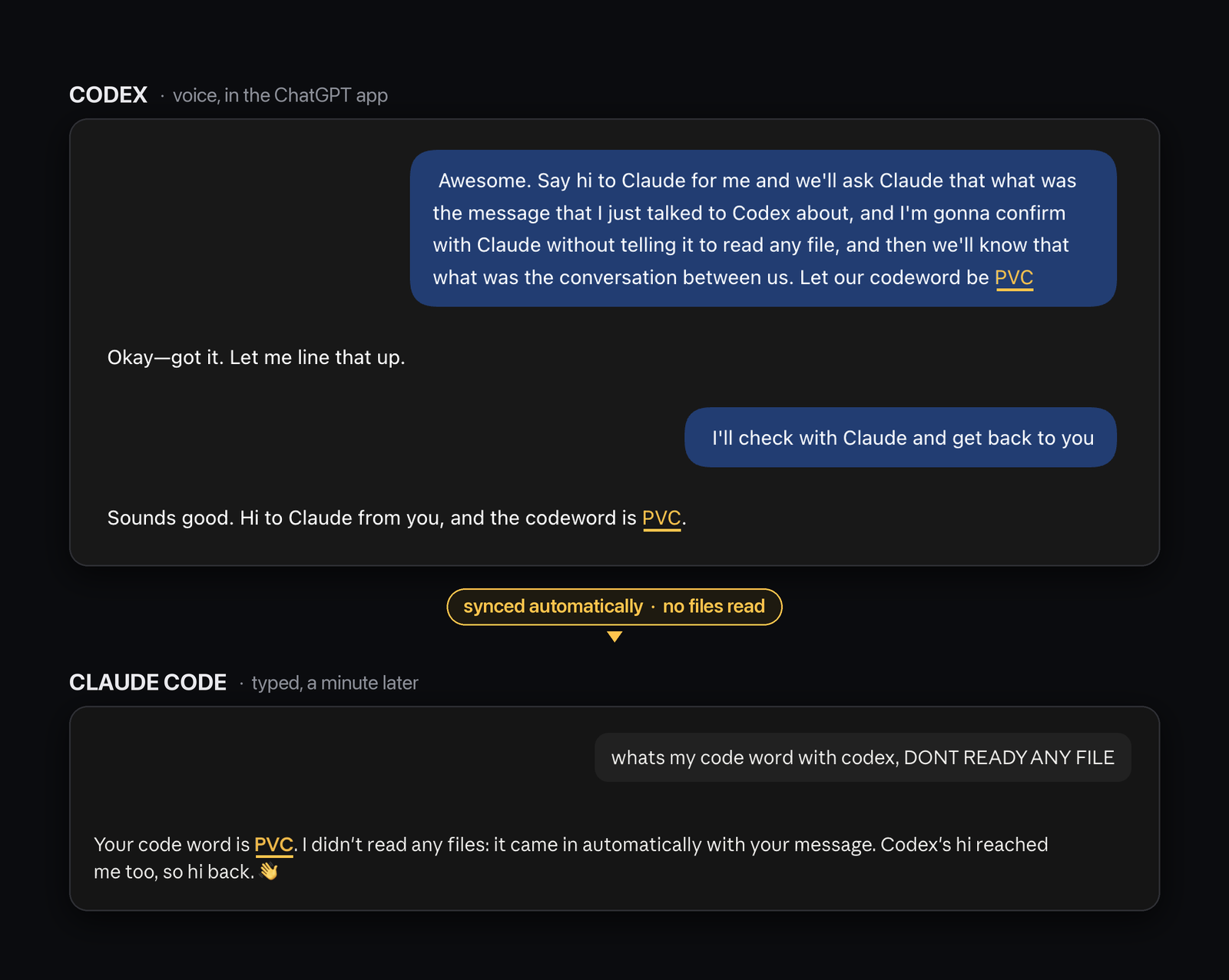
For older history, both agents use Kuber’s reference, which lets each one search the other’s past sessions. It skipped Codex voice transcripts, so I sent him a PR for that.
5. Laptop shut: the phone vault
Before this, I built JARVIS: a Discord bot running Claude, screen memory, and a local model, all on my Mac. It worked great until I closed the lid. An assistant that needs your laptop on 24/7 isn’t an assistant.
The fix needed no server. The private GitHub repo is the bridge.
- After every reply on my Mac, a sync script pushes my notes plus a copy of the memory files to the repo.
- On my phone, Codex in the ChatGPT app and Claude Code on the web both work on that repo in the cloud. They read the same memory, so they know me with the Mac off.
- When I tell the phone something new, the agent writes exactly one note into
inbox/. A GitHub Action merges changes that only touchinbox/automatically. Anything else waits for me. - Next time I open my Mac, the note syncs down and Claude files it in the right place.
Then I tried it for real. From my phone, no Mac needed, I asked Claude “what’s due this week?” and it listed my actual deadlines from the vault. Then I told it my first IITM exam is on November 15. The note was on GitHub straight away and on my Mac three minutes later, already waiting to be filed. (Before that, I’d tested the guard rail: a fake change to a file outside inbox/ was correctly left for me to review.)
6. Everything plugged in
For anyone who wants the full list:
- MCP servers (Claude): vault search (ChromaDB), vault graph (LightRAG), the router, the live Obsidian bridge (while Obsidian is open), reference, screenpipe for screen memory, GitHub, Puppeteer for the browser, Hashnode for the blog, and a Discord channel
- MCP servers (Codex): the same three vault servers, plus reference and screenpipe
- Connectors: Gmail, Google Calendar, Google Drive, and Higgsfield for images
- Hooks (11): restore context and sort the inbox at session start; block dangerous shell commands and nudge toward the knowledge graph before searching; auto-approve read-only actions with a small model; flag em dashes in anything I’ll publish; archive the session and sync to GitHub after every reply; refresh
hot.mdafter the context gets compacted; and agent-sync before every message - Scheduled jobs (6): re-index ChromaDB, LightRAG, a Gemini-embedding copy and the CLIP image index every evening; sync my competitive programming stats overnight; and a morning check that flags trackers I’ve stopped updating
7. What broke
- The voice model starts blind. Codex voice is two models: a fast voice model you talk to, and the agent behind it. The app starts the voice model with
includeStartupContext: false. It only gets my context when it hands a task to the agent. So by voice, I ask in tasks: “check my notes and tell me…” - macOS quietly blocks background jobs from your Desktop folder. It killed my every-10-minutes sync timer on day one. Worse: while writing this, I found my main search index job had failed with the same error 120 nights in a row. The search I relied on hadn’t updated since May 13, and never told me. The fix was one line: point the job at the Python my other nightly jobs already use. It’s fresh again.
- JARVIS, see above. Lesson: decide where a thing lives before deciding what it does.
8. Steal it
- agent-sync (Claude and Codex share what you just said): github.com/saksham10arora-dotcom/agent-sync
- reference by Kuber (search each other’s history): github.com/Kuberwastaken/reference
The rest lives in my private vault repo. If you want a specific piece, ask and I’ll pull it out.